Log Every Trade Outcome Instantly
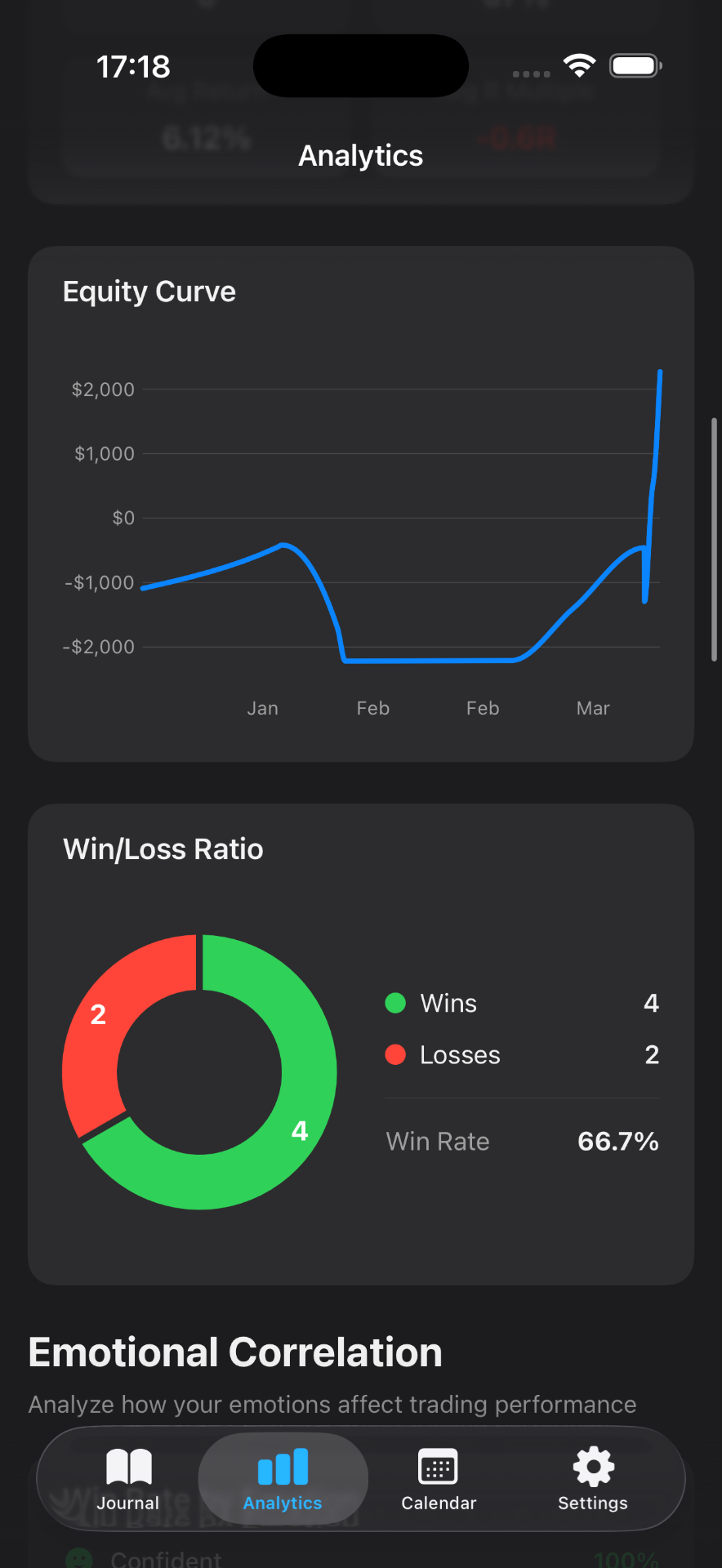
Mantis captures each trade's profit or loss as you close positions, automatically categorizing winners and losers so your win rate updates in real time without manual tallies or spreadsheets.
Your win rate—the percentage of trades that close profitably—is one of the most widely referenced metrics in trading, yet it's often misunderstood. A high win rate doesn't guarantee profitability if your losses outweigh your wins, and a lower win rate can still yield strong returns when paired with disciplined risk management. Tracking win rate in a trading journal helps you understand your accuracy over time, identify which setups or market conditions align with your strengths, and reveal whether your edge comes from frequency or magnitude of wins. By recording every trade outcome consistently, you build a data foundation that separates perception from reality and guides smarter decisions about strategy refinement.
New to win rate? Read the definition, formula & example →
Opens the App Store
Mantis captures each trade's profit or loss as you close positions, automatically categorizing winners and losers so your win rate updates in real time without manual tallies or spreadsheets.
Break down win rate across different strategies, instruments, or session times to discover where your accuracy is strongest and which contexts need adjustment.
View win rate alongside average gain and average loss to understand whether your profitability depends on hitting more trades or hitting bigger trades—critical for calibrating position sizing.
Track how your win rate evolves week-by-week or month-by-month, helping you identify improving discipline or early signs of strategy drift before they compound.
All win rate data and trade records stay stored locally on your iPhone—no cloud sync, no third-party servers—so your performance metrics remain completely private.
A win is any closed trade that results in a net profit after commissions and fees. Break-even trades are typically counted as losses or excluded, depending on your journaling rules. Consistency matters more than the exact definition—pick a method and apply it to every trade you log.
Not necessarily. A 70% win rate with small average gains can underperform a 40% win rate with large average wins. Win rate is most useful when analyzed alongside your average risk-reward ratio and total return, giving you a complete picture of how accuracy and trade size combine to drive results.
A sample of at least 30–50 trades provides a rough baseline, but statistical confidence grows with larger datasets. Early win rates can fluctuate widely due to randomness, so focus on consistent journaling and review trends over hundreds of trades rather than fixating on short-term percentages.
Yes. Aggregating win rate across all trades can hide the fact that one setup performs well while another drags down your accuracy. Tagging trades by strategy, market condition, or timeframe in your journal lets you isolate which approaches deliver reliable results and which need refinement.
No. Mantis stores all trade records and calculated metrics locally on your device only. There is no iCloud sync or cloud backup, ensuring your win rate and journal entries remain private and under your sole control.
Important: Mantis is a trading journal and analytics tool. This page is not investment advice, not financial advice, and not a recommendation to buy or sell any security or instrument. Trading involves risk; past performance does not guarantee future results. Consult a qualified professional before making financial decisions.