Trading psychology is how your emotions, biases and habits shape the trades you take: when you enter, how much you risk and when you exit. Research on brokerage accounts shows investors hold losers too long and that the most active traders earn less. To improve it, write rules before the open and log each trade's emotion so patterns become visible.
What is trading psychology?
Trading psychology is the part of your results that comes from you: the emotions you feel while a position is open, the biases that bend your judgment, and the habits you fall back on under pressure. It decides when you enter, how much you risk, and when you get out.
It helps to separate three things. Your strategy is the edge, the reason a setup should make money over many trades. Risk management is how much you can lose on any one of them. Psychology is whether you actually execute the first two. A sound strategy still loses when you size up after a loss or close a winner the moment it turns green.
You'll often hear that trading is 80% psychology and 20% strategy. Treat that as a saying. No study is behind the split. What has been measured is narrower and more useful: specific mistakes that show up again and again in real account records.
Why does psychology matter so much in trading?
Few activities give you feedback this fast with real money attached. A position can swing from profit to loss in minutes, and in the short run the outcome is partly luck. A bad decision can pay and a good one can lose, so your gut learns the wrong lessons.
Daniel Kahneman and Amos Tversky described the core problem in their 1979 paper on prospect theory. In their model, built from people's answers to hypothetical choices, the value function is generally steeper for losses than for gains. In plain English, losing $100 hurts more than making $100 feels good. That imbalance is called loss aversion, and it's why booking a loss can feel worse than hoping it comes back.
The psychology of trading, as a field of study, is the work of documenting those behaviors in actual trading records. The rest of this guide sticks to what that work found and how to check for it in your own trades.
The biases researchers have measured in real traders
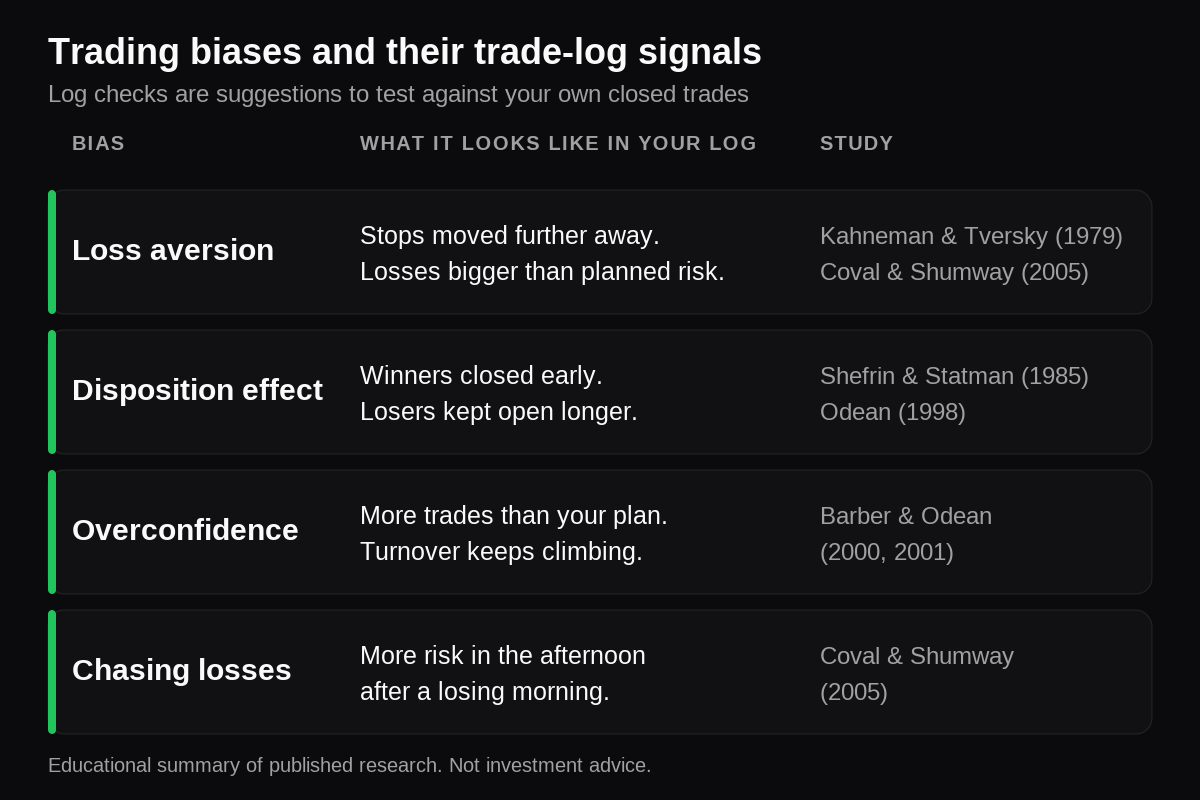
Four patterns have solid evidence behind them. Each one leaves a mark in a trade log, which means you can look for it.
Loss aversion
Because a loss weighs more than an equal gain, you're tempted to postpone it. In a log this shows up as stops moved further away after entry, and as losing trades that end up larger than the risk you planned. Compare your planned risk per trade with your 5 biggest losses. If the losses are several times the plan, this is the first thing to fix.
The disposition effect: cutting winners, holding losers
Hersh Shefrin and Meir Statman described in 1985 a general disposition to sell winners too early and hold losers too long, the pattern now known as the disposition effect. Terrance Odean tested it in 1998 on the trading records of 10,000 accounts at a large discount brokerage. Those investors showed a strong preference for realizing winners over losers. Across a full year they realized 14.8% of the gains they could have taken and 9.8% of the losses.
It cost them. Over the following year, the winners they sold earned 3.4 percentage points more than the losers they kept. To spot it in your own log, compare the average holding time of your winning and losing trades. If your losers stay open noticeably longer than your winners, check for this pattern.
Overconfidence and overtrading
Brad Barber and Terrance Odean studied 66,465 households with accounts at a large discount broker from 1991 to 1996. The households that traded the most earned 11.4% a year while the market returned 17.9%. The title of the paper is its finding: trading is hazardous to your wealth.
A follow-up in 2001 tested the idea that overconfident investors trade too much. Using account data for over 35,000 households, it found that men traded 45% more than women, and that trading cut men's net returns by 2.65 percentage points a year against 1.72 for women. These studies measured how much people traded, not what set it off. To check yourself, compare your trade count and size in the days after a run of wins with a normal week. Tracking overtrading week by week makes any drift visible.
Chasing losses after a bad morning
Professionals do it too. Joshua Coval and Tyler Shumway studied proprietary traders at the Chicago Board of Trade and found that they appear highly loss-averse: traders regularly took above-average risk in the afternoon to recover from morning losses. Prices set by those trades also reversed faster than prices set by other traders, and the authors conclude that the market appears to distinguish them from informed trading.
In your own log, look for size or trade count that jumps after a losing start to the day. Sort your trades by time and look at what you did in the hour after your worst loss.
Fear, greed, FOMO and tilt: how emotions show up in your trades
Biases are the slow-moving part. Emotions are what you feel in the moment, and each one tends to produce a recognizable behavior.
| Emotion | Typical behavior | What to look for in your log |
|---|---|---|
| Fear | Exiting early, skipping valid setups | Winners closed well short of the target you wrote down |
| Greed | Oversizing, moving targets further out | Position size above your own limit on trades that felt certain |
| FOMO | Chasing a move that already happened | Entries far from your planned level, late in the move |
| Tilt | Trading to win back a loss | Several trades in quick succession right after a loss, often larger |
FOMO, the fear of missing out, is the easiest to catch because it leaves a timestamp: you entered after the move, not before it. Journaling FOMO trades separately shows what those late entries earn compared with planned ones.
Tilt is the trader's word for the kind of loss-chasing Coval and Shumway found. You take a loss, feel it, and the next trade is about the feeling. The habit of spotting tilt in your trades starts with marking the trade as it happens, and journaling revenge trades as their own category tells you what the habit costs.
None of this works from memory. If you want the emotion recorded at the moment of the trade, you need a tool for it, such as an app for tagging emotions on every trade, or a column in the spreadsheet you already keep.
How to build trading discipline
Trading discipline is doing what you decided before the session, when you were calm, instead of what you feel like doing mid-trade. In practice it comes down to a short list of rules written in advance, plus limits that end the day before the damage compounds.
- Write entry, exit and size rules before the open. One or two setups, where the stop goes, and how much you risk per trade. A rule you only hold in your head changes under pressure.
- Set a daily loss limit. As an illustration only, not a recommendation: 2% of a $10,000 account is $200. Once you're down $200 on the day, you stop. Your own number depends on your account and strategy.
- Cap the number of trades. A maximum per day keeps a winning streak from turning into overtrading.
- Pause after 2 losses in a row. Step away for a set time. This is the direct counter to chasing losses.
- Run a pre-trade check. Is this one of my setups? Is the size within my rule? Do I know where I'm wrong? If any answer is no, there's no trade.
The limits matter more than the motivation. The traders in the Chicago study were professional proprietary traders, and they still took above-average risk after a losing morning. A hard stop removes the decision at the moment you're worst at making it. If rule-breaking is your main problem, a journal built for discipline goes deeper on tracking it.
Turn emotions into data with a journal
Rules tell you what to do. A journal tells you whether you did it, and what it cost when you didn't. For psychology, two extra fields on every trade are enough:
- The emotion at entry. One word, chosen before you know the result. Tagged afterwards, it becomes a story about the outcome.
- Whether you followed your rules. Yes or no, with a few words in the note if no.
Then review once a week. Group your closed trades by emotion and total the profit or loss for each group. Do the same for rules followed against rules broken. You're looking for one thing: a group that loses money consistently.
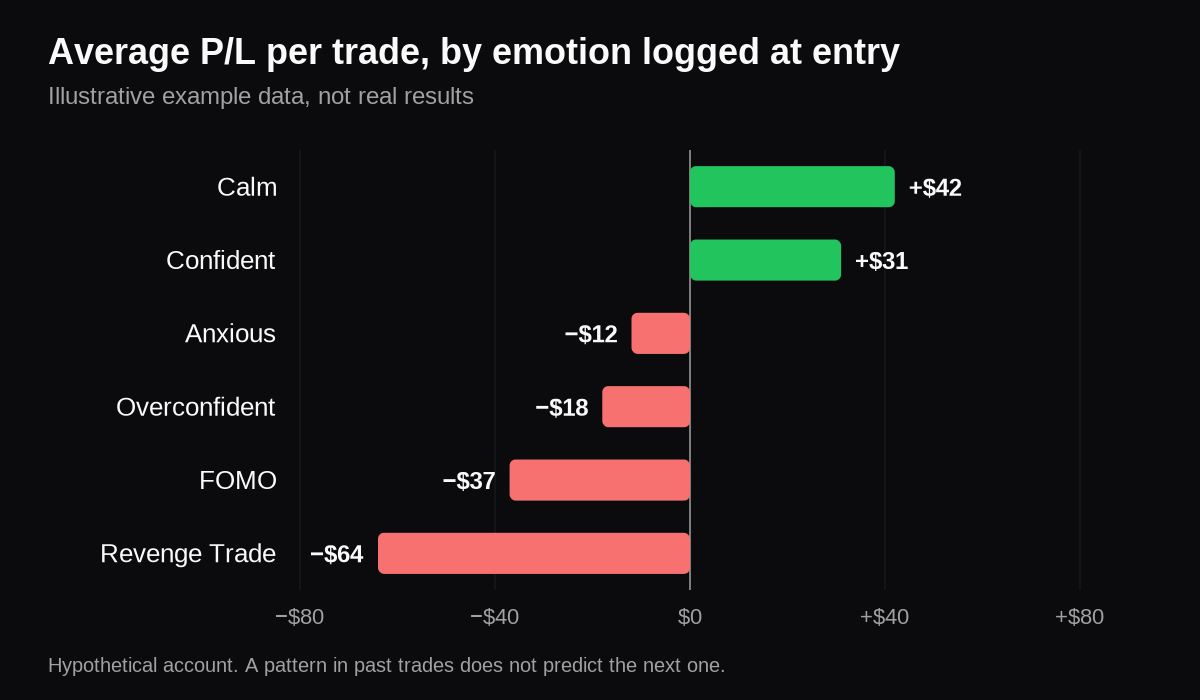
In the made-up example above, calm and confident trades make money, and revenge trades lose more per trade than any other group. A real log is messier, and a few weeks of data is weak evidence. A past pattern doesn't predict the next trade, but it does show you which behavior to put a rule around. The full method, including what else to record, is in how to keep a trading journal.
Where Mantis fits
Paper or a spreadsheet works for all of this. If you'd rather log on your phone, Mantis is an iPhone journal (iOS 18+) where logging a trade takes ~30 seconds and you tag one of 6 emotions: Confident, Anxious, FOMO, Revenge Trade, Calm, or Overconfident. Emotion logging is free for up to 10 trades a month. Whether you followed your rules goes in the trade's note.
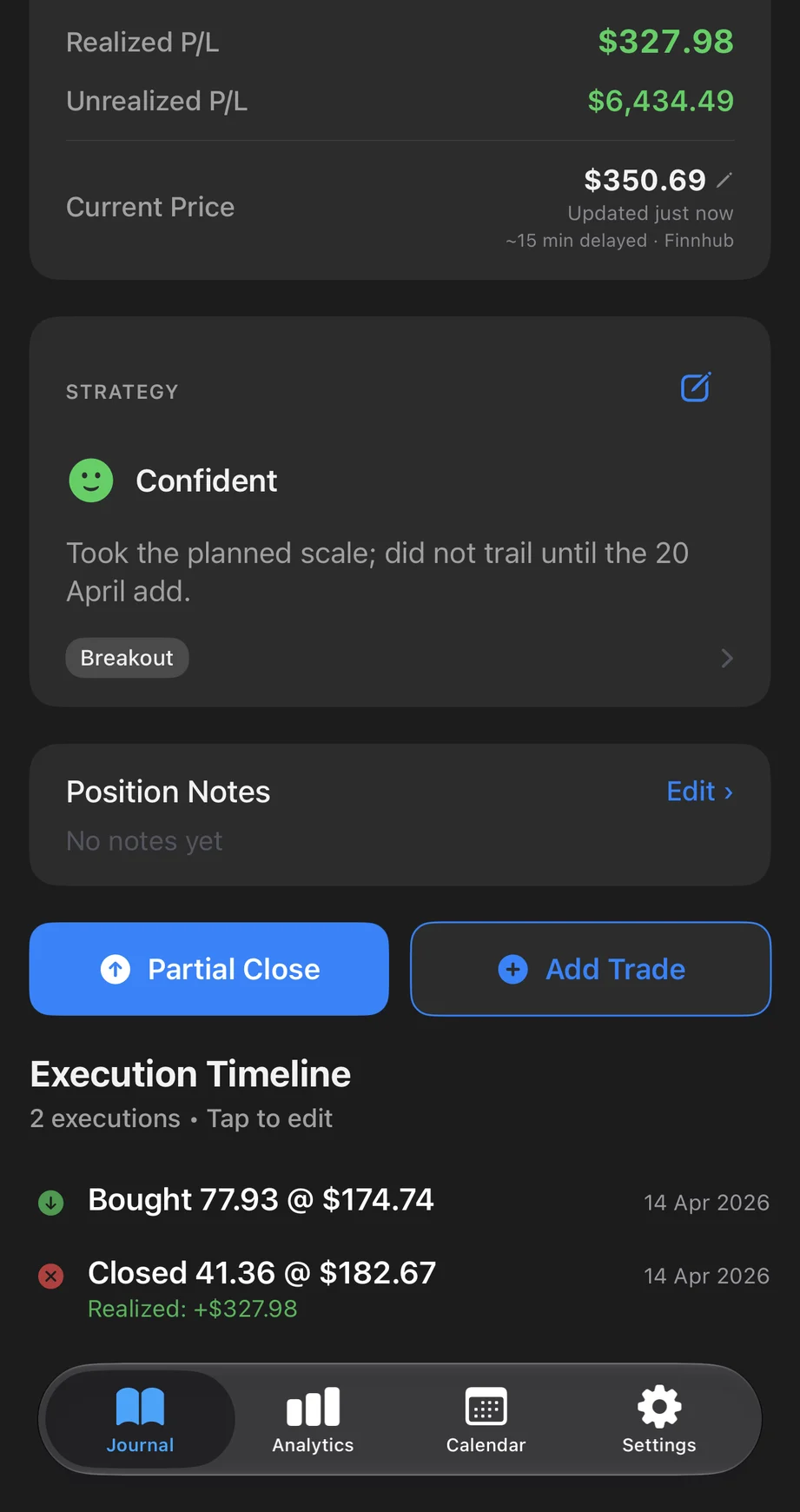
In the app, emotion analytics (your P/L and win rate grouped by emotion) is Premium, and so are weekly behavioral reports. Premium is $4.99 a month or $29.99 a year in the US with a 7-day free trial, and prices vary by region. All data lives on your device. No account, no cloud sync.
Opens the App Store
Do you need a trading psychologist?
Most traders don't, at least not first. A trading coach works on performance: routines, reviewing your decisions with you, and holding you to the rules you set. Some trading psychologists do the same performance work and some are also licensed clinicians, so ask about credentials. Either can help once you have a record to review. Without a log, there's little for anyone to work with, so start with the journal.
Performance coaching is different from clinical care. If trading is causing you real distress, if it feels compulsive, or if you're trading money you can't afford to lose, talk to a licensed mental-health professional or your doctor. A journal builds awareness. It doesn't treat anything, and this guide can't assess your situation.
For self-study, the best trading psychology books cover the same ground from the trader's side. Our Trading in the Zone summary walks through one of them, Mark Douglas's book on thinking in probabilities. Read them alongside your own data, since your log is the only source that describes you.
A 10-minute daily routine for steadier trading
The habits above fit into about 10 minutes a day, plus one longer review a week.
- Before the open (3 minutes). Read your rules. Write down today's maximum size and daily loss limit. Note your state in one word. If it's anxious or angry, cut size or sit out.
- During the session. Pause after a loss before placing anything new. No new setups once you hit the daily limit or the trade cap.
- After the close (5 minutes). Log every trade with its emotion and whether you followed your rules. Do it the same day, while you still remember how each one felt.
- Once a week (20 minutes). Group P/L by emotion and by rules followed. Pick one behavior to change next week, and write it as a rule.
One change a week is slow on purpose. You're replacing a reaction with a rule, and each rule gets tested against your next set of trades.
Frequently asked questions
What is trading psychology?
Trading psychology is how your emotions, biases and habits affect your trading decisions: when you enter, how much you risk and when you exit. It's separate from your strategy and your risk rules. It covers whether you actually follow them when real money is moving.
How do I improve my trading psychology?
Write your entry, exit and size rules before the session, set a daily loss limit, and pause after 2 losses in a row. Then log the emotion you felt on every trade and whether you followed your rules. Review weekly, grouping profit and loss by emotion, and turn the worst pattern into a new rule.
What is trading discipline?
Trading discipline is carrying out the plan you made before the session instead of reacting to how a trade feels. In practice it's a short list of written rules plus hard limits, such as a daily loss limit and a maximum number of trades, that stop you before emotions take over.
Do you need a trading psychologist?
Most traders can start with written rules and a journal. A trading coach, or a trading psychologist doing performance work, is most useful once you have a record to review. If trading causes real distress, feels compulsive, or involves money you can't afford to lose, speak to a licensed mental-health professional.
Is trading psychology more important than strategy?
You need both. A strategy without an edge loses however calm you are, and a good strategy loses when you don't execute it. The popular line that trading is 80% psychology is a saying, not a measurement. Studies of real accounts do show that behavior, such as holding losers and overtrading, lowers returns.
Sources
- Kahneman, D. and Tversky, A. (1979). Prospect Theory: An Analysis of Decision under Risk. Econometrica 47(2), 263–291.
- Shefrin, H. and Statman, M. (1985). The Disposition to Sell Winners Too Early and Ride Losers Too Long: Theory and Evidence. Journal of Finance 40(3), 777–790.
- Odean, T. (1998). Are Investors Reluctant to Realize Their Losses?. Journal of Finance 53(5), 1775–1798.
- Barber, B. M. and Odean, T. (2000). Trading Is Hazardous to Your Wealth: The Common Stock Investment Performance of Individual Investors. Journal of Finance 55(2), 773–806.
- Barber, B. M. and Odean, T. (2001). Boys Will Be Boys: Gender, Overconfidence, and Common Stock Investment. Quarterly Journal of Economics 116(1), 261–292.
- Coval, J. D. and Shumway, T. (2005). Do Behavioral Biases Affect Prices?. Journal of Finance 60(1), 1–34.