The trading psychology books to start with depend on your problem: Mark Douglas's Trading in the Zone for thinking in probabilities, Jared Tendler's The Mental Game of Trading for tilt, fear and greed, Tom Hougaard's Best Loser Wins for taking losses, and Brett Steenbarger's The Daily Trading Coach for building a habit of reviewing yourself.
Which trading psychology books are worth reading?
Many lists of the best trading psychology books rank by popularity. This one starts from the problem in your own trades, because a book about tilt won't help a trader who hesitates.
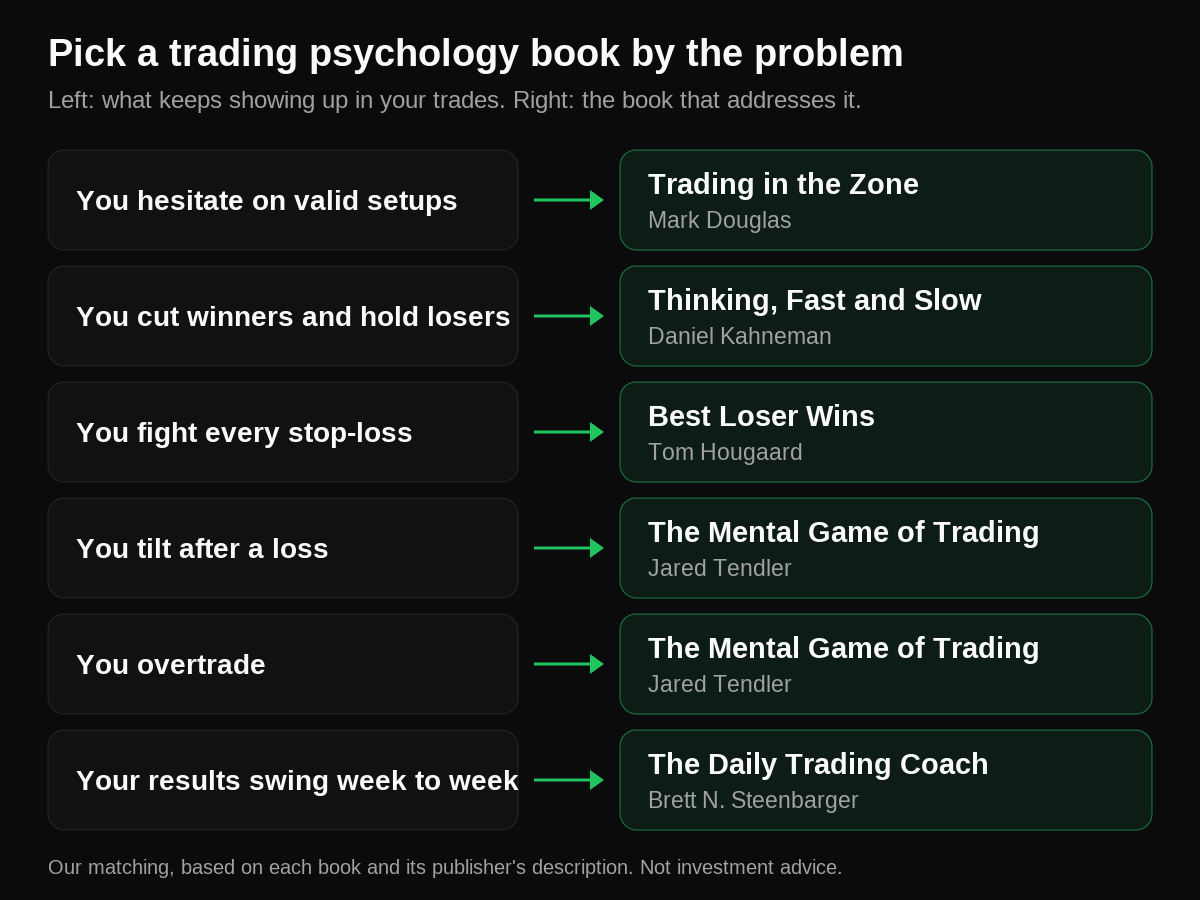
| If this is your problem | Read | Why |
|---|---|---|
| You hesitate on valid setups | Trading in the Zone (Mark Douglas) | It teaches you to judge yourself over a series of trades. |
| You cut winners and hold losers | Thinking, Fast and Slow (Daniel Kahneman) | It explains loss aversion and prospect theory, which help explain both habits. |
| You fight every stop-loss | Best Loser Wins (Tom Hougaard) | It argues that taking small losses calmly is the skill. |
| You tilt after a loss | The Mental Game of Trading (Jared Tendler) | It treats anger, fear and greed as patterns you can map. |
| You overtrade | The Mental Game of Trading (Jared Tendler) | Its publisher names overtrading as one of its targets. |
| Your results swing week to week | The Daily Trading Coach (Brett N. Steenbarger) | It gives you 101 short lessons, one a day. |
How we chose these books
Each book passed 4 tests:
- It's about trading, or applies directly to placing and managing trades.
- It gives you exercises, not only stories (the 2 classics at the end are the exception).
- The publisher or the author states the author's background.
- It's in print, with a publisher listing we could link.
The order follows the problem each book addresses, not sales rank or ratings. Dates come from publisher or author pages, and we say where a book is usually dated differently. There are no affiliate links. The exercises are ours, built on each book's ideas.
Best for thinking in probabilities: Mark Douglas
Trading in the Zone
Mark Douglas. Prentice Hall Press. The publisher's page dates the hardcover to 2001, and many listings date the book to 2000.
Douglas argues that traders who know their setups still lose because they treat each trade as a test of being right. His answer is to think in probabilities: accept the loss before you enter, and judge yourself over a series of trades. For the 5 truths and the 7 principles, read our Trading in the Zone summary.
- Read it if: you hesitate on valid setups, move stops, or grab small profits.
- Skip it if: you don't have a defined strategy yet. The book assumes you already have an edge.
- Try this: take the next 20 trades that fit your setup. Log each result in R-multiples and whether you followed your rules, and judge nothing before trade 20.
The Disciplined Trader
Mark Douglas, with Paula T. Webb credited on Tarcher's updated edition. The publisher's page dates it to April 1990.
Douglas's first book is the theory behind the second: how your beliefs about money and risk form, and why your mind resists what the market shows you.
- Read it if: you know your rules and can't explain why you keep breaking them.
- Skip it if: you want something short and practical.
- Try this: for a month, every time you break a rule, write down the sentence you told yourself just before.
Read Trading in the Zone first. The summary's comparison of the two books explains why.
Best for tilt, fear and greed: The Mental Game of Trading
Jared Tendler. Released in April 2021 by JT Press, according to the Apple Books listing.
Tendler is a mental game coach whose clients, his site says, include traders, golfers and poker players. He treats emotional mistakes as performance flaws with causes you can find, and the publisher's description names overtrading and cutting winners short among them.
- Read it if: losses set off tilt, revenge trades or overtrading.
- Skip it if: you want market strategy. There isn't any here.
- Try this: pick one tilt trigger that keeps coming back, such as a second loss before lunch. For 2 weeks, log every time it fires: what happened, what you felt, and what you did next.
Best for building a self-review habit: Brett Steenbarger
The Daily Trading Coach
Brett N. Steenbarger. Wiley. Published in March 2009, according to the publisher's page.
Steenbarger holds a Ph.D. and writes the TraderFeed blog, where he says he has worked with traders at proprietary firms and hedge funds. The book is 101 short lessons on coaching yourself, best taken one at a time.
- Read it if: your results swing week to week and you never review yourself.
- Skip it if: one framework matters more to you than variety. The lessons don't add up to one system.
- Try this: read one lesson before the open, then write one journal note after the close on whether you used it.
Best for losses and the biases behind them
Thinking, Fast and Slow
Daniel Kahneman. First published in 2011, the year of the earliest editions on Penguin's page.
Kahneman, who won the Nobel Prize in Economics in 2002, explains how fast, intuitive thinking makes errors that slow, deliberate thinking often misses. For traders, the key idea is loss aversion: a loss hurts more than an equal gain pleases, from his 1979 paper with Amos Tversky. It helps explain why banking a small winner and waiting out a loser both feel right. The trading psychology guide covers how this shows up in real brokerage accounts.
- Read it if: you cut winners early and hold losers.
- Skip it if: you want trading examples. It's about everyday decisions, and Penguin's paperback runs 624 pages.
- Try this: compare how long you held the winners and the losers among your last 20 closed trades. If you held the losers longer, that's the pattern to work on.
Best Loser Wins
Tom Hougaard. Harriman House. Published on 16 August 2022, according to the publisher's page.
Hougaard worked at JPMorgan Chase and has traded his own money since 2009, according to his publisher. His publisher calls him a high-stakes retail trader. His argument: whoever takes small losses calmly outlasts whoever fights them.
- Read it if: you widen stops, add to losers, or freeze when a trade goes against you.
- Skip it if: you want a method. A review quoted on the publisher's page says it doesn't offer one.
- Try this: before each trade, write the dollar loss at your stop. Afterward, mark whether you took that loss as planned, moved the stop, or got out early.
Classic trading stories that teach psychology indirectly
These 2 are a novel and a set of interviews. Read them once you've worked on a specific problem.
Reminiscences of a Stock Operator
Edwin Lefèvre. First serialized in the Saturday Evening Post in 1922, according to Wiley, which publishes a 2010 annotated edition. Many listings date the book to 1923.
It's a fictionalized account of the speculator Jesse Livermore: a gifted trader who goes broke more than once and keeps naming his own mistakes.
- Read it if: you learn better from a story than from a list of rules.
- Skip it if: you want instructions.
- Try this: as you read, list every mistake the narrator admits to, then tick the ones you made in the last month.
Market Wizards
Jack D. Schwager. Wiley published the updated edition in February 2012, according to its publisher's page. Many listings date the original to 1989.
Schwager interviews successful traders about how they work. Their methods differ, but Wiley sums up what they share as a solid method plus the right mental attitude.
- Read it if: you keep hunting for a new system.
- Skip it if: you need exercises. This is interviews.
- Try this: after each interview, write the trader's rule for cutting losses in one sentence, then yours. If you can't, that's your next task.
How to turn a book into a trading habit
Reading about discipline changes nothing until it shows up in your trades. Keep it small:
- Pick one book for one problem, the one you see most in last month's trades.
- Run one exercise at a time, so you know which one worked.
- Tag the trades where you practiced it. A tag or a short note is enough. See how to keep a trading journal for what else to record.
- Review after 30 days. Compare the tagged trades with the rest: fewer broken rules, smaller losses, steadier sizing. If nothing moved, change the exercise before the book.
You don't have to buy these to start. Public libraries lend ebooks and audiobooks through their apps, and publishers often post a free sample chapter. Skip the free PDFs in search results. For books still in copyright, a free PDF the publisher didn't post is almost always pirated.
Where Mantis fits
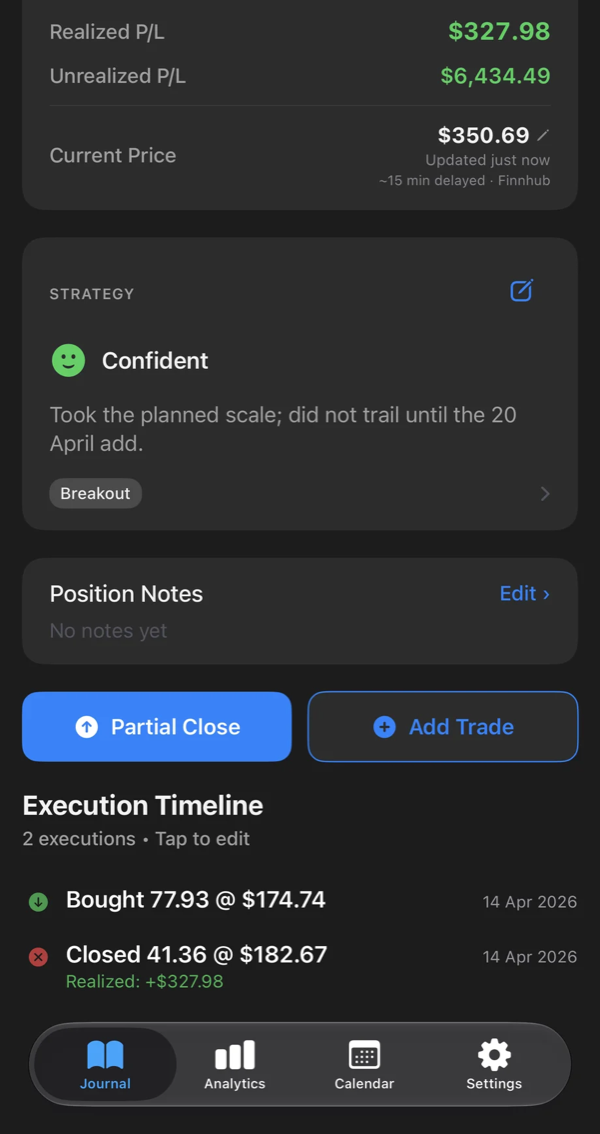
Each exercise works better when the behavior it targets is on the trade record. A notebook works. If you'd rather log on your iPhone, Mantis is an app for tagging emotions on every trade, built for iOS 18+, and it takes ~30 seconds to log a trade.
Each trade can carry a strategy tag, a note on the exercise, and an emotion: Confident, Anxious, FOMO, Revenge Trade, Calm or Overconfident. Logging emotions is free, and the free tier covers 10 trades a month.
Emotion analytics (your P/L and win rate by emotion) is Premium, and so are past weeks of the weekly behavioral report. Premium is $4.99 a month or $29.99 a year in the US with a 7-day free trial, and prices vary by region.
All data lives on your device. No account, no cloud sync.
Opens the App Store
Frequently asked questions
What is the best book on trading psychology?
It depends on the problem you want to solve. If you have a strategy and don't follow it, start with Trading in the Zone by Mark Douglas. If tilt, fear or greed drive your mistakes, The Mental Game of Trading by Jared Tendler fits better. If you can't take a loss calmly, read Best Loser Wins by Tom Hougaard.
Which trading psychology book should a beginner read first?
Write your trading rules first, because most of these books assume you already have a strategy. Market Wizards is a good read in the meantime, since it shows how differently successful traders work. Once you have rules and a few weeks of trades, read Trading in the Zone.
Are there free trading psychology books?
You can read most of these free through a public library, which lends ebooks and audiobooks through its apps, and publishers often post a sample chapter on the book's page. Avoid free PDF downloads from other sites. For books still in copyright, a free PDF the publisher didn't post is almost always pirated.
What are the best books for a trading mindset?
For a mindset built on probabilities rather than being right, read Trading in the Zone. For accepting losses, read Best Loser Wins. For why your instincts mislead you, read Thinking, Fast and Slow. Then test one idea at a time in your trading journal.
Sources
- Douglas, M. (2001 hardcover). Trading in the Zone: Master the Market with Confidence, Discipline, and a Winning Attitude. Prentice Hall Press, Penguin Random House book page.
- Douglas, M. (1990; updated edition with P. T. Webb). The Disciplined Trader: Developing Winning Attitudes. Tarcher, Penguin Random House book page.
- Tendler, J. (2021). The Mental Game of Trading: A System for Solving Problems with Greed, Fear, Anger, Confidence and Discipline. JT Press, Apple Books listing (release date, publisher and publisher description).
- Jared Tendler. The Mental Game of Trading. Author's book page, jaredtendler.com.
- Steenbarger, B. N. (2009). The Daily Trading Coach: 101 Lessons for Becoming Your Own Trading Psychologist. Wiley, publisher's book page.
- Brett Steenbarger. TraderFeed. Author's blog.
- Kahneman, D. (2011). Thinking, Fast and Slow. Penguin, Penguin UK book page (editions, page count, author bio).
- Kahneman, D., & Tversky, A. (1979). Prospect Theory: An Analysis of Decision under Risk. Econometrica, 47(2), 263–291.
- Hougaard, T. (2022). Best Loser Wins. Harriman House, publisher's book page.
- Lefèvre, E. (2010 annotated edition). Reminiscences of a Stock Operator, Annotated Edition (annotated by Jon D. Markman). John Wiley & Sons, Wiley-VCH book page.
- Schwager, J. D. (2012 updated edition). Market Wizards: Interviews with Top Traders, Updated. Wiley, publisher's book page.