Trading in the Zone by Mark Douglas argues that inconsistent results come from how traders think, not from a lack of analysis. Douglas asks you to think in probabilities: accept that any single trade can lose, define your risk in advance, and judge yourself on executing your edge across a series of trades rather than on any one outcome.
What is Trading in the Zone about?
Trading in the Zone is a book about why traders who know their setups still lose money. Its answer is that the problem usually sits in how they think about each trade. If you want a Trading in the Zone summary in one line: stop trying to be right on every trade, and start acting like someone running a probability game.
The edition in print is a 240-page hardcover from Prentice Hall Press (ISBN 978-0-7352-0144-6), which the publisher's page dates to 2001. Many listings date the book to 2000 instead. Its subtitle is Master the Market with Confidence, Discipline, and a Winning Attitude.
The book assumes you already have a strategy and asks why you don't follow it.
Trading in the Zone by Mark Douglas: the core idea
Douglas's publisher's bio says he began coaching traders in 1982 and went on to run seminars on the mental side of trading. In our reading, this book is the most practical version of the trading psychology Mark Douglas taught.
His central claim is that most traders treat each trade as a test of whether they're right. A loss then feels like being wrong, and being wrong hurts.
So information that goes against your position starts to feel like a threat. You hesitate on the next entry, move a stop to avoid the pain, or grab a small profit before it can disappear.
Trading without fear, in Douglas's sense, means you've already accepted the loss before you click buy, so nothing the market does afterward can threaten you. The "zone" in the title is that state: you see what's on the screen and act on your rules without the internal argument.
The other half is responsibility. The market owes you no result and has no idea your position exists. Every outcome follows from decisions you made, which is uncomfortable but also the only version where you can improve.
The trading psychology guide covers the research on how fear of losses shows up in real account records.
The 5 fundamental truths, in plain English
Douglas lists 5 fundamental truths about the market. Taken together, they explain why you have to judge yourself over a series of trades. Each one below is in our own words, with an example from a trade log.
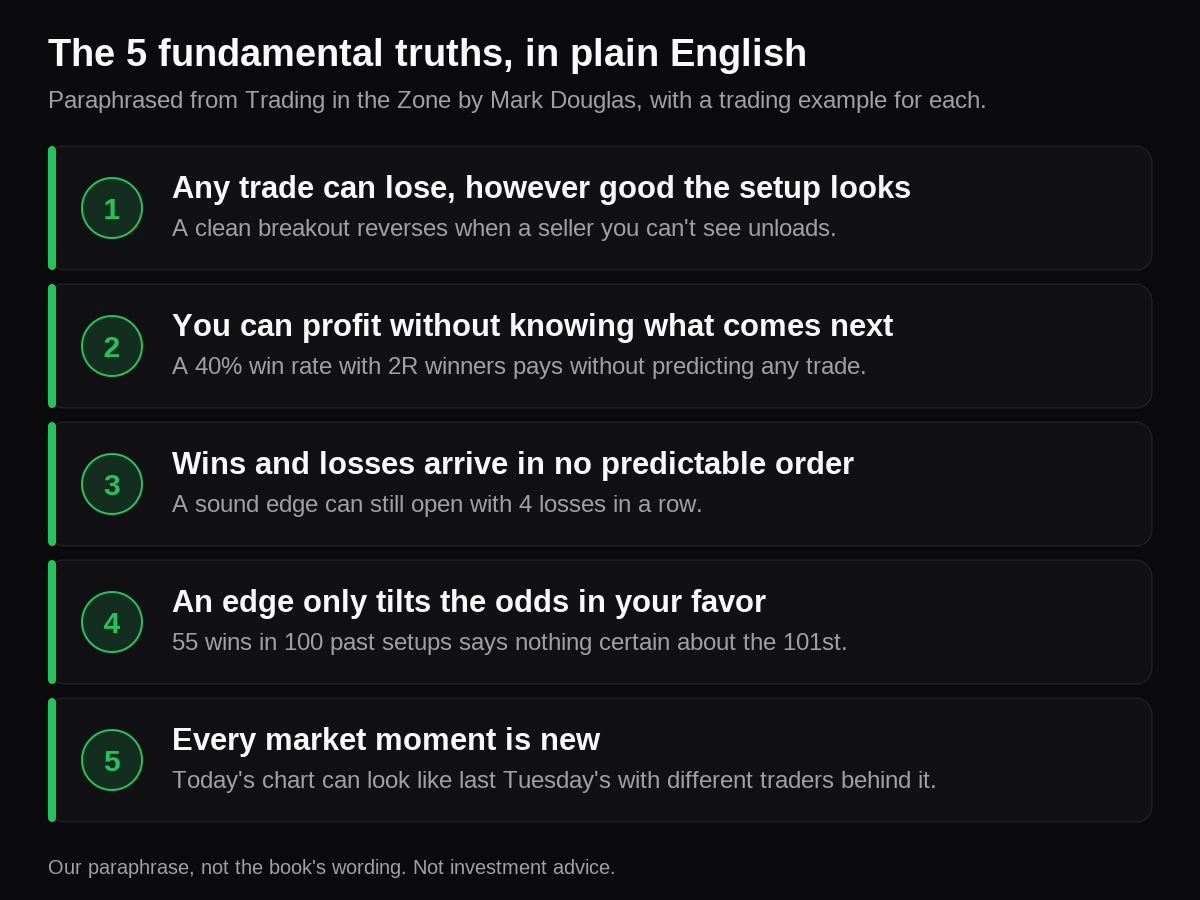
1. Any trade can lose, however good the setup looks
Order flow you can't see, a headline, or one large seller can turn the cleanest pattern. Say you buy a breakout on heavy volume and it reverses within the hour. Your read was fine, and the trade landed on the losing side of the odds.
Believe this before you enter and the loss stops being a verdict on you. That's what lets you take the stop instead of arguing with it.
2. You can profit without knowing what comes next
A trader who wins 40% of the time, with winners twice the size of the losers, comes out ahead over a long run without knowing how any single trade will end. The money comes from the gap between average win and average loss, repeated many times.
3. Wins and losses arrive in no predictable order
Even an edge that works over hundreds of trades deals its wins and losses in an order you can't forecast. A strategy that wins 6 times out of 10 can still open a month with 4 losses in a row.
A streak like that is what a random order looks like from the inside, and on its own it says nothing about whether the edge still works.
4. An edge only tilts the odds in your favor
An edge only means one result has been somewhat more likely than the other in the past. If a setup has worked 55 times in 100 past occurrences, the next one is still a coin that happens to be slightly weighted.
Treat it as a promise and you'll double your size after a few losses, sure the next one has to work.
5. Every market moment is new
Two charts can look identical and still be different situations, because a different mix of traders is acting on them. The pattern that stopped you out last Tuesday has no memory of you.
Douglas's point is that carrying last week's pain into today's setup makes you see a threat that isn't there.
Thinking in probabilities: why one trade tells you nothing
Douglas leans on a comparison with a casino. A casino has no idea whether the next hand of blackjack will go to the house, and it runs fine anyway.
The rules give it a small edge, and over thousands of hands that edge shows up in the results. So the staff stay calm when a player wins big.
A trader with a real edge is in the same position, only with fewer hands. Here's an invented 20-trade run to show what that looks like:
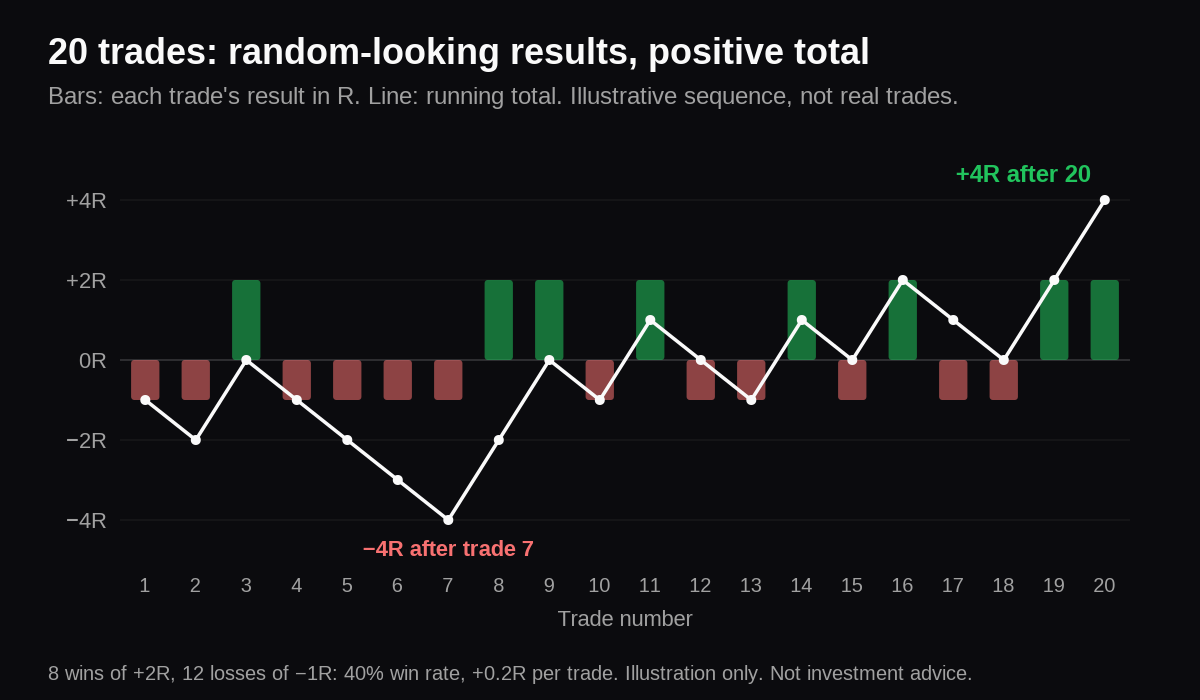
This trader wins 8 trades at +2R and loses 12 at −1R, where R is the amount risked on each trade. After 7 trades they're down 4R, and after 10 they're still down. A trader judging the strategy at that point could easily quit.
By trade 20 the account is up 4R, an average of +0.2R per trade, which is what the expectancy of this edge predicts.
To read your own trades this way you need to define your risk in R-multiples, so a $50 loss and a $500 loss count the same when each was a full planned stop.
The 7 principles of consistency, paraphrased
Douglas also sets out 7 principles of consistency, the habits a consistent trader keeps. He writes them as first-person commitments. The table puts each one in simpler words, next to what it looks like when you write it down.
| # | The principle, in our words | What it looks like in your journal |
|---|---|---|
| 1 | Define your edge in terms anyone could check: market, setup, entry trigger. | Every trade carries a setup tag. A trade you can't tag wasn't your edge. |
| 2 | Decide what you'll lose before you get in. | The stop and the planned risk are written down before the order fills. |
| 3 | Accept that loss completely, or pass on the trade. | A note when you hesitated, shrank the size, or nudged the stop. |
| 4 | When your setup appears, take it without second-guessing. | Missed setups get a line too, so you can see what hesitation cost. |
| 5 | Take profits as the market offers them, by a plan you set in advance. | Each exit is marked as planned or early. |
| 6 | Watch yourself for mistakes as closely as you watch the chart. | A weekly count of broken rules, by rule. |
| 7 | Treat these rules as non-negotiable. | A followed-the-rules yes or no on every trade, and the streak it builds. |
All 7 are about how you behave around the setup you already have, so a journal can track every one of them.
How to apply the book in your journal: a 20-trade exercise
The truths are hardest to believe when you're 4R down. This exercise is ours, built on the book's ideas, and it turns them into something you can measure in a few weeks.
- Write down one edge. One market, one setup, with the entry trigger, stop placement and exit rule spelled out. If two people could read it and disagree about whether a trade qualifies, it isn't written tightly enough.
- Fix your risk at 1R and keep it there. Pick a dollar amount you can lose 6 or 7 times in a row without changing your behavior, and size every trade so the stop costs exactly that. The risk management guide covers how to choose the number.
- Take the next 20 trades that fit. All of them. Skipping one because the last few lost breaks the sample.
- Log 3 things on every trade. The result in R, whether you followed every rule (and which one you broke if not), and the emotion you felt when you entered.
- Don't judge anything before trade 20. Then add up the R, compare trades where you followed the rules with trades where you didn't, and look at which emotions sit next to the broken rules.
At the end you'll know two separate things: whether the edge made money over 20 trades, and whether you actually traded it. If the rule-broken trades carry most of the losses, work on execution before you touch the strategy.
Then run the next 20 with the same rules. For a template for the log itself, see how to keep a trading journal.
Where Mantis fits
A notebook or spreadsheet works for this. If you'd rather log on your iPhone, Mantis is a trading journal app for iOS 18+ that takes ~30 seconds to log a trade.
You record each execution with its stop, a strategy tag for the setup, notes on which rule you followed or broke, and an emotion: Confident, Anxious, FOMO, Revenge Trade, Calm or Overconfident. Logging emotions is free.
The free tier covers 10 trades a month, so a 20-trade sample takes 2 months. R-multiple tracking and unlimited trades are part of Premium, which is $4.99 a month or $29.99 a year in the US with a 7-day free trial, and prices vary by region.
All data lives on your device. No account, no cloud sync.
Opens the App Store
Trading in the Zone vs The Disciplined Trader
Douglas wrote two books on the subject. The Disciplined Trader: Developing Winning Attitudes came first, in 1990, according to the publisher's author bio. It's mostly about how beliefs form and why the mind resists the market, and it reads like theory.
Trading in the Zone came about a decade later and is the more practical follow-up. It's built around thinking in probabilities, the 5 truths and the 7 principles, so most of its ideas translate straight into rules you can write down.
Start with Trading in the Zone. Go back to The Disciplined Trader if you finish it and want the longer argument about where your beliefs about money and risk come from. For other books matched to the problem they address, see the best trading psychology books.
Is Trading in the Zone worth reading?
Yes, if you already have a defined strategy and keep failing to execute it. It's written for the trader whose results suffer from the hesitation and stop-moving described above, and it names that problem clearly.
It has real limits. It repeats its core ideas many times, and it contains no strategy and no method for sizing positions. It also assumes you have an edge, which many newer traders don't yet.
Thinking in probabilities won't rescue a strategy that loses money over 100 trades. So skip it for now if you don't have written rules yet.
Build a simple strategy and a risk limit first, then read it once you have a few weeks of trades to compare it with. Paired with a fixed risk per trade and an honest journal, it's one of the more useful books a discretionary trader can read.
Frequently asked questions
What is Trading in the Zone about?
It argues that inconsistent trading results usually come from how traders think rather than from weak analysis. Mark Douglas asks you to treat each trade as one outcome in a series, accept the risk before you enter, and judge yourself on following your edge, not on whether a single trade wins.
What are the 5 fundamental truths in Trading in the Zone?
In plain English: any trade can lose; you can profit without knowing what comes next; wins and losses arrive in no predictable order; an edge only tilts the odds; and every market moment is new. Douglas's own wording differs, so read the book for his exact phrasing.
How many pages is Trading in the Zone?
The Prentice Hall Press hardcover (ISBN 978-0-7352-0144-6) has 240 pages, according to the publisher's page. The audiobook runs 7 hours 57 minutes.
Is Trading in the Zone worth reading?
It's worth reading if you have a defined strategy but execute it inconsistently. It won't give you a strategy or a position-sizing method, and it repeats itself, so traders without written rules should build those first and read it afterward.
What is the difference between Trading in the Zone and The Disciplined Trader?
The Disciplined Trader (1990) is Douglas's earlier, more theoretical book about how beliefs shape trading. Trading in the Zone (Prentice Hall Press hardcover, 2001) is the practical follow-up built around thinking in probabilities, the 5 fundamental truths and the 7 principles of consistency. Most readers should start with Trading in the Zone.
Sources
- Douglas, M. (2001 hardcover). Trading in the Zone: Master the Market with Confidence, Discipline, and a Winning Attitude. Prentice Hall Press, Penguin Random House book page (formats, ISBN, pages, audiobook runtime, author bio).